Synthwave never pretends to be anything but fake 80s: drum machine hits, pads drowning in chorus, a plucky bass that refuses to sit still. Nostalgia was never the point of Serum 2, yet it handles every piece of this sound; the trick is fighting off the modern defaults.
Below is the whole kit: bass, pads, arps, leads, plus the drum treatment holding it all together.
The bass: square, short, dry
What drives the genre is a bass hammering straight eighth notes, usually hopping between octaves.
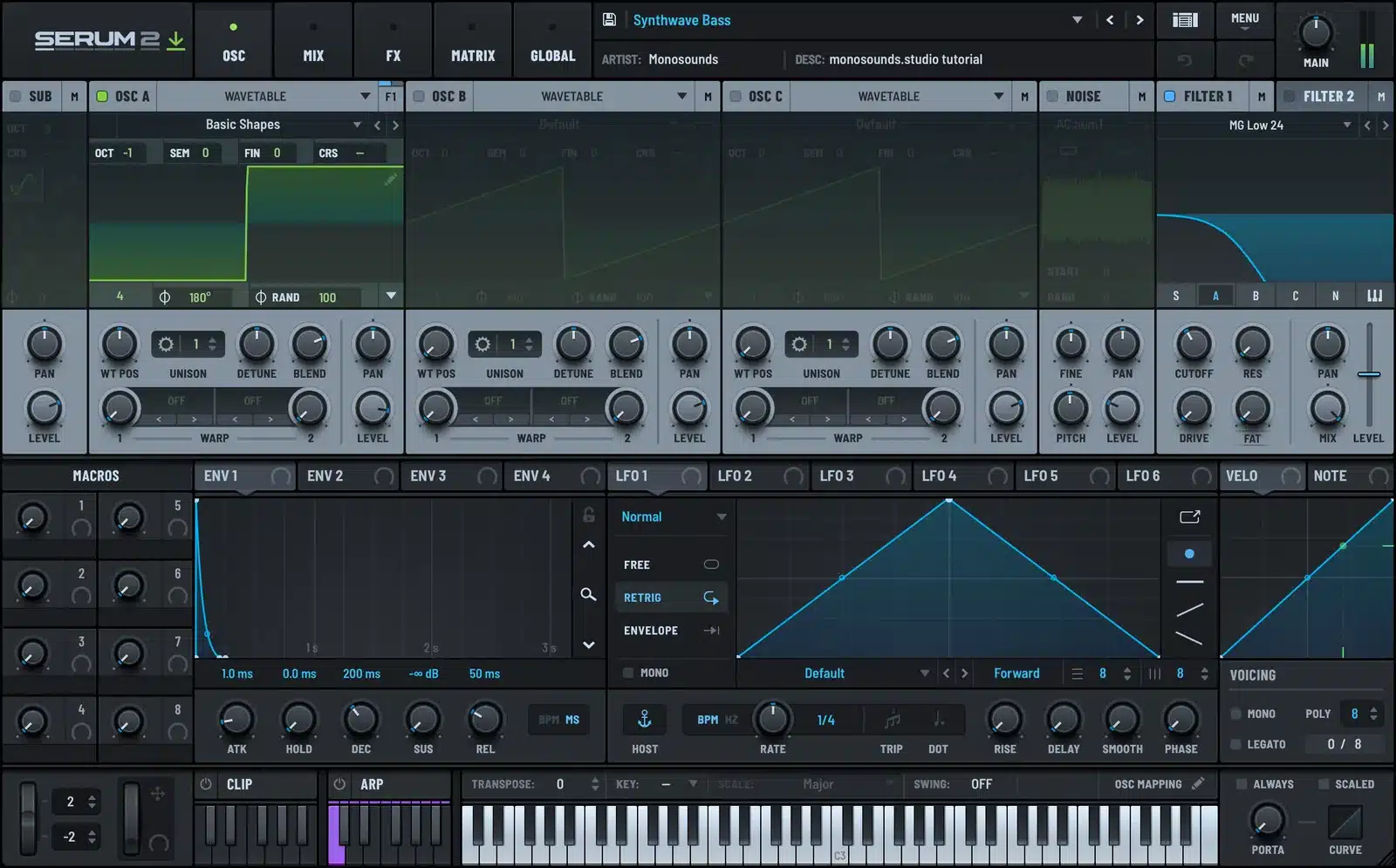
- A single oscillator on a square-ish wavetable. Skip unison, or keep it minimal.
- Amp envelope: attack at zero, decay 200–400 ms, sustain low. You want pluck, not drone.
- A lowpass near 1–2 kHz, keyboard tracking enabled, so higher notes brighten on their own.
- Write straight eighths, hit the octave jumps harder, and never let the line rest.
The touch that brings it to life: a slow LFO on wavetable position, faking pulse-width drift. A square that never moves sounds frozen; one whose width wanders sounds like the analog hardware this whole genre is impersonating. If you’re asking “why does mine sound stiff”, this single modulation is most of the answer.
Pads: saws plus chorus equals 1985
The modern instinct is seven stacked oscillators. The 80s answer: one detuned saw stack, a lowpass parked around 5–6 kHz, and chorus. That chorus IS the era: the famous Juno pad is basically a single oscillator with a chorus circuit carrying the entire load.
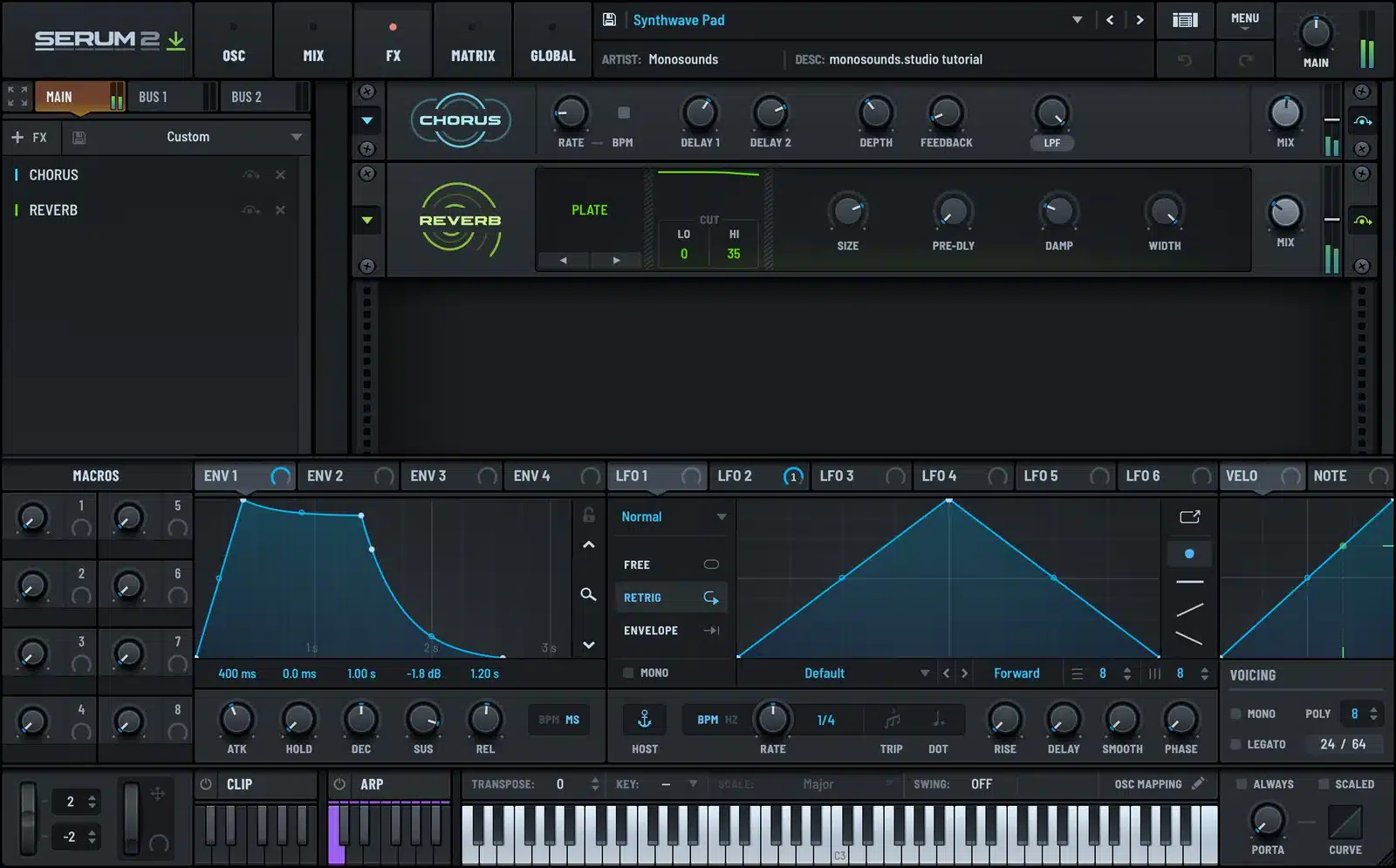
Voice pads darker and narrower than anything you’d use in modern EDM. Attack on the slow side, release long, and noticeably fewer unison voices than a big-room supersaw calls for. The exact border between those two worlds is mapped out in the supersaw guide.
For that register, this demo carries the wide, emotional stack character:
Arps do the driving
The midsection of the genre rides on Serum 2’s arpeggiator: rate at 1/16, up or up-down mode, range of two octaves. Push velocity on every fourth step so the pattern rolls forward instead of ticking like a clock.
Resist the urge to make the arp itself busier. Hang a dotted-eighth delay on it instead. The delay drops syncopation into the gaps without you programming a thing, and that’s the unglamorous secret behind most of the arps you’ve been admiring. More pattern ideas live in the arpeggiator and sequencer article.
Leads: glide and delayed vibrato
Solo leads need portamento: dial in a modest glide time and runs start smearing between notes. Then comes the true 80s giveaway: delayed vibrato. Send an LFO to fine pitch, but ramp the depth so the vibrato blooms only about half a second into each note. Vibrato from the first millisecond sounds jittery; vibrato that arrives late sounds like an actual player.
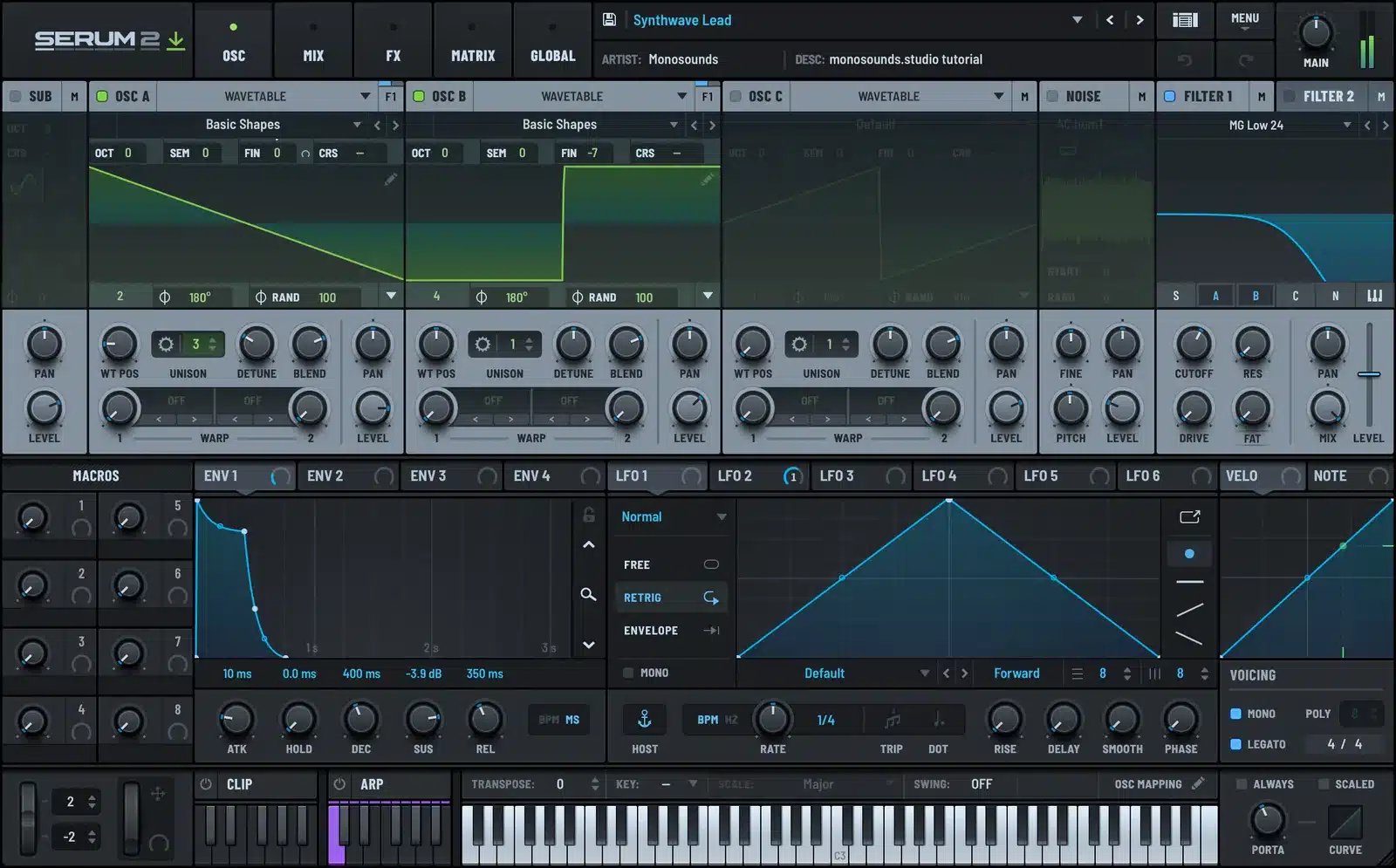
Here’s a big detuned lead demo — from a modern pack, though the stacking logic could be lifted straight from 1984:
Drums and the gated reverb feel
Serum 2 isn’t a drum machine and forcing it into that role is wasted effort. Pull LinnDrum-style and 808-style one-shots from sample packs, then pour your energy into the snare instead: a huge room reverb, chopped off hard after roughly 100–200 ms. Gated reverb — enormous, then instantly gone — remains the most recognizable production signature the decade produced.
Keep the programming straight, zero swing. Kick on every beat or a plain rock pattern, snare on 2 and 4. The stiffness isn’t a flaw here; it’s the style.
Glue: wobble and chorus everywhere
Three finishing moves:
- A whisper of pitch drift on pads and keys: a slow LFO on fine tune at ±2–4 cents stands in for tape and aging oscillators.
- Chorus on nearly everything besides the bass and kick. Whenever a sound reads too digital, chorus is the first thing I reach for.
- A gentle sidechain pump on pads and bass against the kick. Disco lent this move to synthwave, and it fits.
For working patches to keep open while you build, the free Serum 2 presets download includes plucks and pads worth dissecting for their envelope and chorus settings. And once this style becomes a regular thing for you, the Serum 2 preset bundles are flatly the cheapest per-patch option: pay once, strip out whatever parts you need.
FAQ
What BPM is synthwave?
The bulk of it lands between 90 and 115 BPM. Darksynth and chase-scene material runs hotter, but that classic cruising feel lives near 100.
Do I need analog synths?
No. The aesthetic is carried by chorus, pulse-width motion and a little pitch drift: all modulations, none of them circuits.
Why do my pads sound too modern?
Too bright, too wide, too many voices. Close the filter down, drop the unison count, and let chorus provide the width instead. The retro-leaning packs in our full Serum 2 preset range come voiced narrow for exactly this reason, if a reference helps.
Straight or swung drums?
Straight. Machine stiffness is the genre’s whole charm; add swing and it turns into funk, and now you’re making a different record.
Synthwave pays off restraint more than it pays off sound design skill. Fewer layers, more chorus, a bass that never stops running. That’s the entire neon skyline.
I run Monosounds.studio and make the packs myself. Ten-plus years of producing, 97+ releases, 16,000+ downloads. Every Serum 2 preset we ship passes a CPU check on a mid-range laptop and gets used in a real track before release. If it does not survive a mix, it does not go in the pack.
More about Maxim & the studio →

