One good cowbell preset can push a sketch across the line into record territory. It’s a tiny sound carrying serious weight: the offbeat in tech house rides on it, latin-leaning grooves swing on it, and it tops off half the percussion loops in dance music.
Below I take apart how cowbells get built in Xfer Serum 2 — the two-square-wave trick that made the classic 808 bell, the envelopes, the tuning — and 15 free presets come with the article, so you’re starting from professional patches instead of an init screen.
Keep this in mind throughout: a cowbell is tuned percussion. Handle it as melody and it cooperates; handle it as a drum and it picks fights with your track.
Start with the free pack
Get the Free Serum 2 Cowbell Presets: 15 Cowbell presets, audio demo per patch, all royalty-free. Under a minute to install: unzip into the Serum 2 user preset folder, rescan.
The collection spans dry classic drum-machine bells for tech house and electro, longer resonant ones aimed at afro and latin house, plus a few distorted, aggressive takes for the harder stuff. And since these are synth patches rather than samples, they play in key — which is precisely the point of a preset over a one-shot.
Made for producers whose percussion loops feel lifeless and who want a top layer that actually tunes to the track.
The sound, part by part
The classic drum-machine cowbell
Two square or pulse oscillators set to a deliberately non-musical interval: a tritone and a little extra, so they grind against each other. That intentional dissonance is where the metallic clank lives.
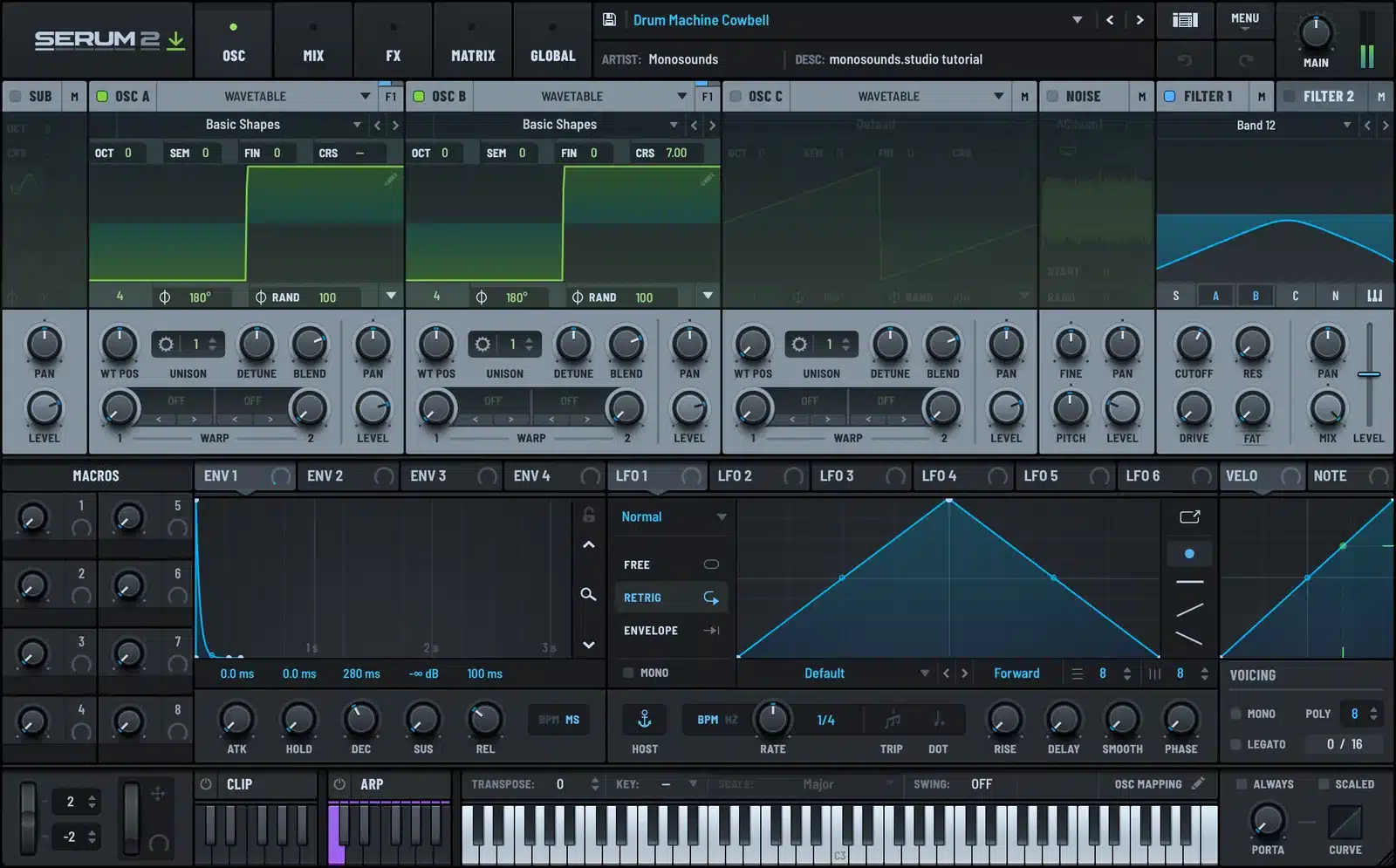
Center a band-pass filter somewhere between 800 Hz and 1.2 kHz, resonance near 40%. Amp envelope: zero attack, 120–250 ms decay, zero sustain. Go past 300 ms and it stops behaving like percussion. Which band-pass types hold onto their body at high resonance is covered in the filter guide.
The resonant afro/latin bell
Same two-oscillator concept, but stretch the decay to 300–500 ms and narrow the band-pass higher up, around 1.5–2 kHz. Then add a quick pitch envelope dropping a semitone over 40 ms. That’s what makes it sound struck.
Blend a whisper of filtered noise under the attack, about 20 ms worth, and you get the stick-on-metal impression. Keep it tiny; the moment it registers as noise, it’s too loud.
The distorted hard version
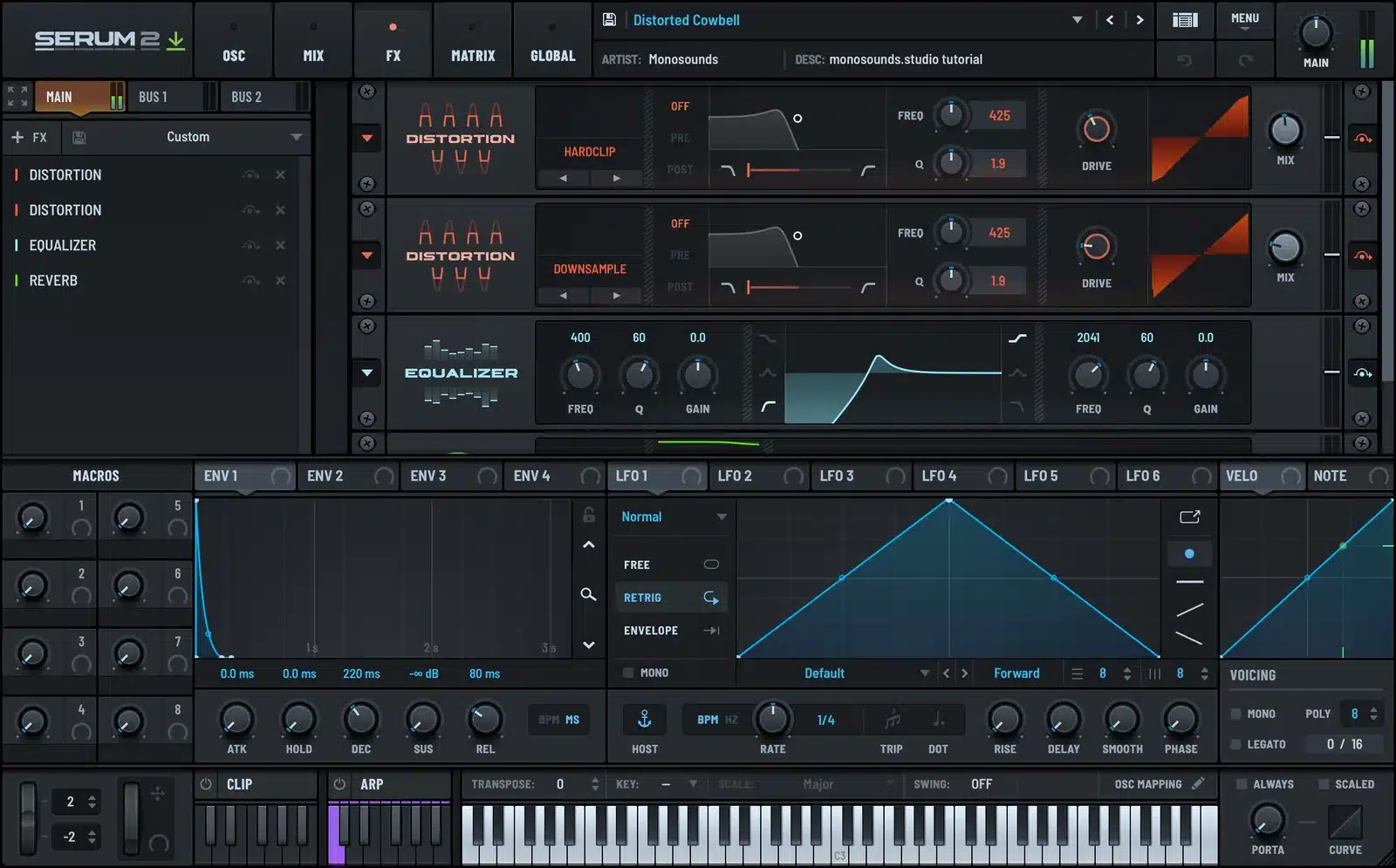
Start from the classic patch, push it into a soft clipper, then band-pass a second time after the distortion so the new harmonics stay contained. Serum 2’s filter and FX routing makes placing that second filter post-drive trivial, and that ordering is the thing standing between you and noise.
Tuning, which is the real skill
Pitch the cowbell’s root to the root or fifth of your track. An untuned cowbell sitting over an F minor bassline is the number one reason percussion loops sound cheap.
With a two-oscillator clash patch, tune only the lower oscillator to the track and let the upper keep its offset. The metallic character stays; the wrong-note feeling goes.
Tempo, groove and arrangement
Its natural habitat is tech house at 124–128 BPM: offbeat eighths, or just the “and” of 2 and 4, which is less busy and usually the better call. Afro house at 120–124 prefers longer patterns, five or seven hits stretched over two bars, so the loop never repeats quite where the ear expects.
Velocity work isn’t optional here. Fix the velocity and the cowbell sounds like a machine within four bars. Spread it 20–30% across the pattern, and route velocity to filter cutoff on top of level.
A habit worth adopting: program the cowbell against the bassline rather than the drums. Tech house treats bass and offbeat percussion as one interlocking mechanism; the tech house bass guide handles the other side of that partnership.
Mixing notes for cowbells
High-pass at 400–500 Hz. Nothing useful lives below that point, and removing it keeps the cowbell out of the kick’s territory.
Low-pass near 8–10 kHz. A raw cowbell is harsh, and shaving the top lets you push level without the pain.
Pan it somewhere. Dead center it fights the snare and vocal. Try 20–30% to one side with a 15–25 ms short delay on the opposite side: width, no stereo plugin required.
Rather than lowering it overall, duck it 2 dB under the snare or clap. It stays present in the gaps and gets out of the way where it would clutter.
Compress with a slow attack to let the transient through. On percussion this short, a fast attack deletes the only part worth keeping.
Common mistakes
Skipping the tuning. Pitch it to the track’s root and tuned percussion starts functioning as melody.
Overlong decay. Beyond 300 ms you’ve got a bell tone that implies harmony you never wrote.
One velocity for the entire pattern. Nothing screams “programmed” faster.
One patch doing every job. Two cowbells (a dry, short one holding the main offbeat and a longer, wetter one for accents) beats a single loud one every time. And if finding patches fast enough is the bottleneck, spend twenty minutes with the preset organisation guide.
When you outgrow the freebies
These 15 patches share design sessions with our Serum 2 preset bundles, whole genre collections for a fraction of what single packs cost. Only need one genre? The rest of the wider Serum 2 preset library sells pack by pack.
FAQ
Do these presets work in Serum 1?
No, the Serum 2 engine is required. Serum 2 is a free update if you own Serum 1.
How do I make a cowbell sound in Serum 2 from scratch?
Two square oscillators at a clashing interval, a resonant band-pass around 1 kHz, and an amp envelope set to zero attack, 150 ms decay, zero sustain.
My cowbell sounds out of tune with the track. How do I fix it?
Tune the lower oscillator to your key’s root or fifth and leave the upper at its offset. Still clashing? Drop the entire patch an octave and high-pass it back into position.
Are they really royalty-free?
Yes. Releases, client work, beats you sell, no credit needed.
Can I use them in any DAW?
Anywhere Serum 2 loads: Ableton, FL Studio, Logic, Cubase, Studio One and the rest.

I run Monosounds.studio and make the packs myself. Ten-plus years of producing, 97+ releases, 16,000+ downloads. Every Serum 2 preset we ship passes a CPU check on a mid-range laptop and gets used in a real track before release. If it does not survive a mix, it does not go in the pack.
More about Maxim & the studio →

