Some genres just refuse to die, and eurobeat is the prime example. Japan pushed it to its peak in the 90s, Initial D memes handed it a second life, and here in 2026 it still racks up millions of streams. Through all of that, the core of the sound never changed: loud, detuned, gloriously over-the-top synth leads.
Making Serum presets is my job, and eurobeat happens to be one of the very first genres I ever packaged into a pack. Below I’ll break down what the eurobeat sound is actually made of, walk through programming it in Serum 2, and point you at presets worth grabbing if sound design isn’t how you want to spend your evening.
If this article rings a bell: the original version dates back to 2022 and targeted Serum 1. When Serum 2 landed in March 2025 as a free upgrade for Serum 1 owners, I rebuilt the whole post around it – the three oscillators, five engines and built-in sequencer all pull their weight for this genre.
What eurobeat actually is
Eurobeat evolved from Italo disco and Hi-NRG toward the end of the 80s. Its history has a funny twist: production happens mostly in Italy while the audience lives in Japan, where labels like Avex spent decades putting out the Super Eurobeat compilations.
Behind the entire genre stands a surprisingly small crew of Italian producers and vocalists: Mauro Farina, Dave Rodgers, Clara Moroni, Maurizio De Jorio, Alessandra Gatti and a few more, frequently hiding behind dozens of aliases each. When a track feels like the output of a whole scene, odds are decent it was three people in a studio outside Brescia.
Sonically, the formula holds steady:
- Tempo: the classics live around 150-160 BPM, early tracks dip to 125, newer ones climb toward 190.
- A synth bass jumping octaves relentlessly, start to finish.
- Fat detuned saw leads running fast melodic lines.
- Theatrical vocals, key changes, and rock guitars often tucked underneath the synths.
The synths ARE the genre’s identity. Nail the lead and the bass and 80% of the work is done.
How to build a eurobeat lead in Serum 2
This is the patch I rebuild constantly. Five minutes, give or take.
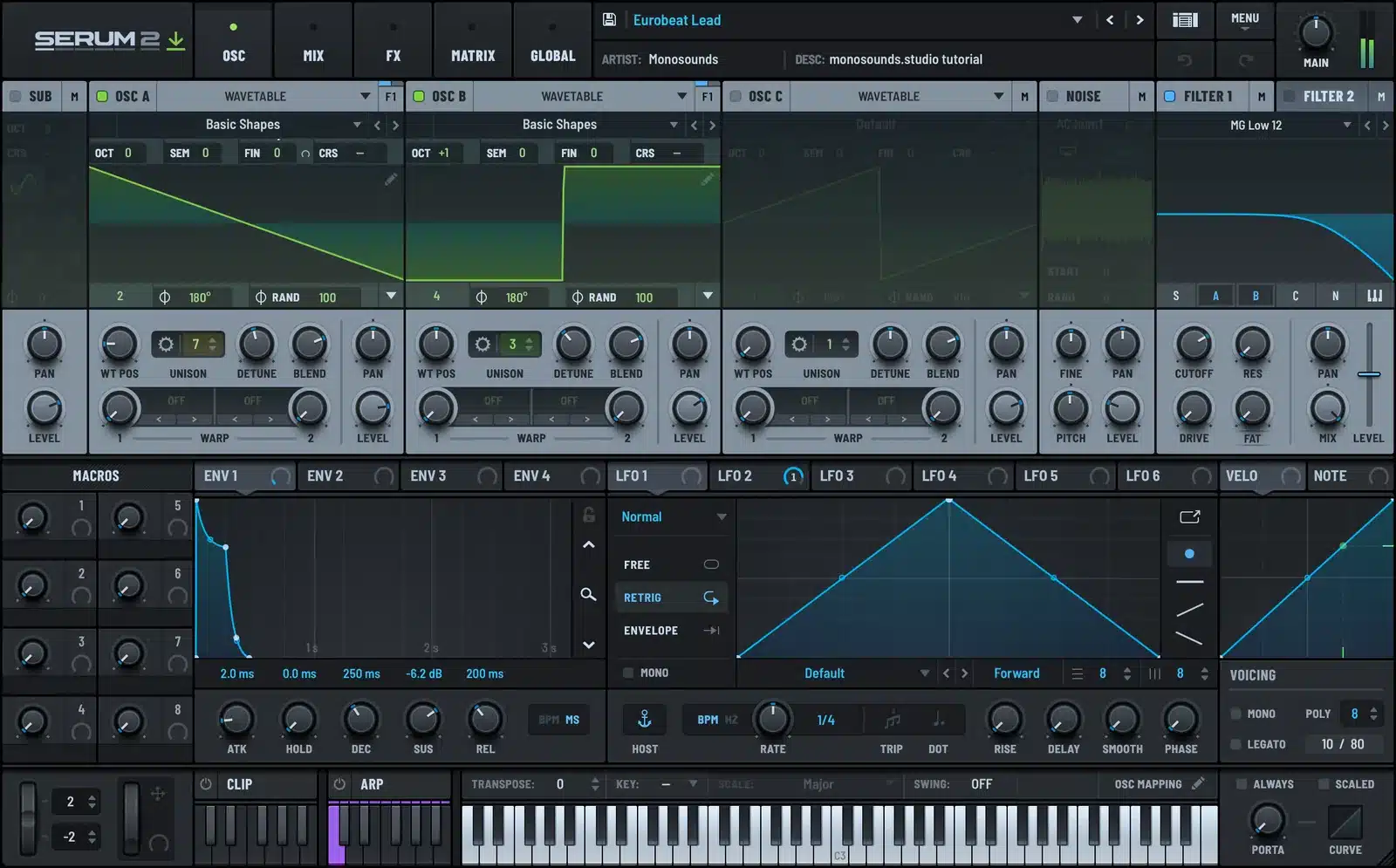
Oscillators. Osc A: a basic saw wavetable, unison at 7, detune in the 0.18-0.25 range, blend at 75% so the center voice keeps its edge. Osc B: the same saw an octave higher, unison 3, pulled down roughly 6 dB. Serum 2 adds a third oscillator, and my habit is a quiet square there for midrange bite – or flip it to the Spectral engine when a glassier top end fits better.
Envelope. Sustain maxed, attack at zero, release near 150 ms. Since eurobeat leads get played staccato, the envelope can stay dead simple; the performance carries it.
Vibrato. Here’s the detail everyone skips. Send an LFO (sine, roughly 5.5-6 Hz) to global pitch at around 20-30 cents, with its onset delayed by 200-300 ms. Nothing screams “eurobeat” louder than that delayed vibrato blooming on held notes.
Effects. Hyper/Dimension at 2-3 unison for width, a compressor gluing the voices, then a plate reverb kept mostly dry (15-20% mix) and a 1/8 ping-pong delay near 20%. The new FX buses in Serum 2 let you route only the lead’s tail into reverb while the attack stays dry – do it, because fast runs stay clean that way.
If stacked detuned saws are new territory, my supersaw guide for Serum 2 digs further into unison, blend and width, while the modulation guide handles LFO routing tricks like that vibrato move.
The bass: octave jumps at 158 BPM
Think of the eurobeat bassline as percussion in disguise. One mono synth, root notes bouncing up an octave and back in straight eighths or sixteenths, running the full length of the track without a break.
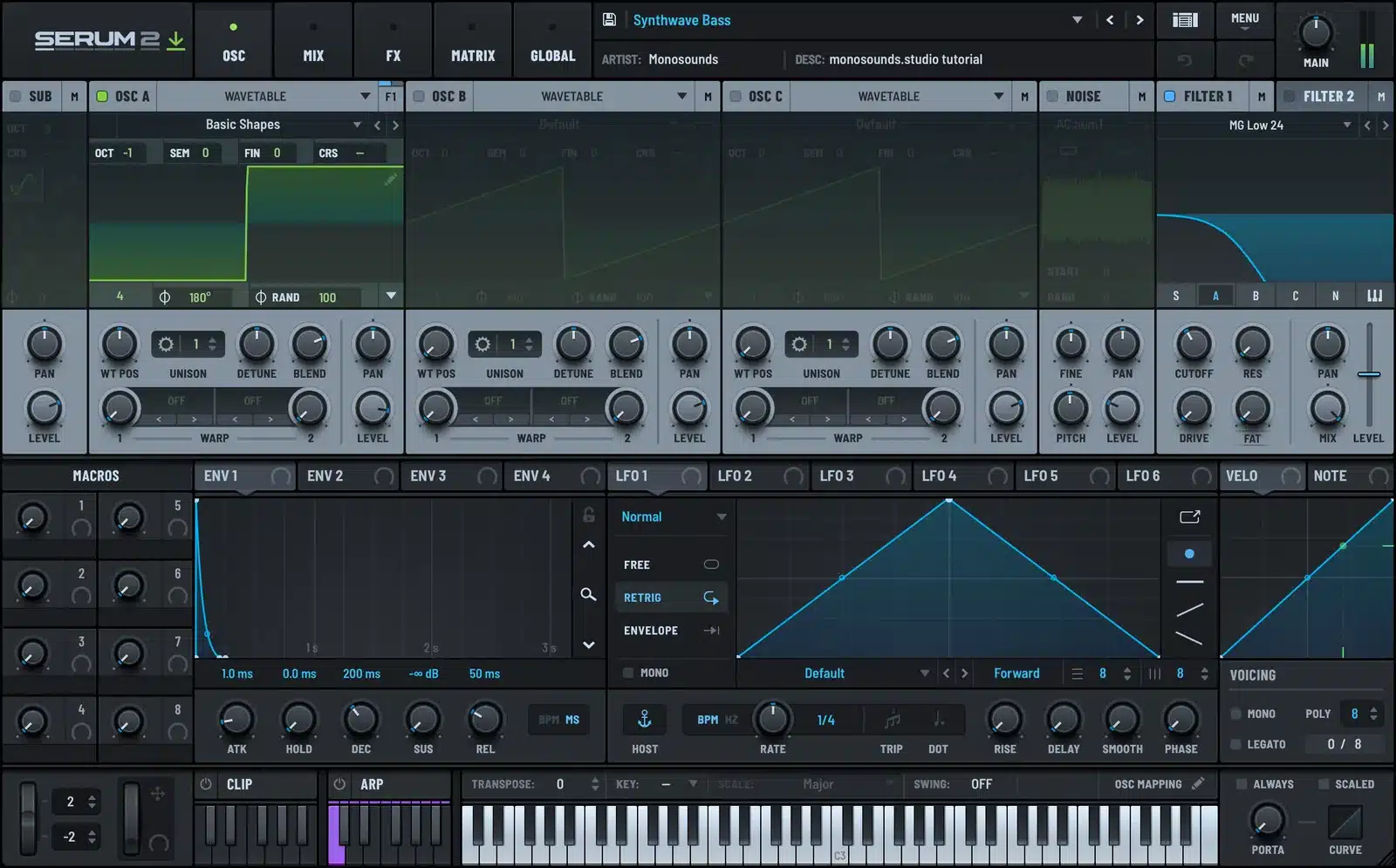
The Serum 2 version: single saw oscillator, a square one octave down, no unison, mono mode plus a touch of glide (10-20 ms). For the filter, low-pass sitting around 400-700 Hz with envelope-modulated cutoff giving a short pluck. Attack zero, decay near 200 ms, sustain low. Finish with distortion – tube or soft clip – dialed just far enough to growl.
This is where Serum 2’s built-in sequencer earns real points. Write the octave pattern into the preset once, hold a single key, and the bassline runs itself. What once demanded an external MIDI pattern now lives inside the patch.
Presets that get you there faster
Don’t feel like building any of this by hand? Selling that shortcut is literally my business. Our Eurodance Presets for Serum 2 pack descends directly from the old eurobeat pack this post first showcased – leads, plucks and basses modeled on the classic Super Eurobeat sound, then reworked for Serum 2. A taste of what’s in there:
Two other packs from our catalog fit this style nicely. Creative Leads for Serum 2 Vol.1 carries aggressive detuned leads that slot straight into a eurobeat mix, and for that neighboring big-room energy, the Future Rave Serum 2 Presets share plenty of DNA with today’s high-BPM eurobeat.
Prefer to dip a toe in for free? The 271 free Serum 2 presets include lots of leads and basses you can bend into eurobeat shape using the settings above. And if nothing shows up after installing, here’s how to install Serum 2 presets the right way.
What about other synths?
Nearly any subtractive or wavetable synth can do eurobeat. The originals came off hardware: the Roland JP-8000 (where the supersaw was born) and the Korg M1. These days the standard picks are Xfer Serum 2, Sylenth1 and Vital.
My vote still goes to Serum 2 for this genre. High voice counts stay clean in its unison engine, layering is trivial thanks to the third oscillator, and the octave bass never has to leave the plugin because of the sequencer. Weighing the free alternative? My Serum 2 vs Vital comparison shows where each synth comes out ahead.
FAQ: eurobeat production
What BPM is eurobeat?
The bulk of classic Super Eurobeat sits in the 150-160 BPM window. Late-80s material ran slower, around 125-140, while some modern tracks push clear up to 190. In doubt? 158 is your starting point.
What synth is used in eurobeat?
Back in the day, hardware such as the Roland JP-8000 and Korg M1. Now it’s almost all software, and Serum 2 handles everything the genre asks for: detuned supersaw leads, octave basses, brass stabs, orchestra hits.
Do the old Serum 1 eurobeat presets still work in Serum 2?
Yes. Serum 1 presets open in Serum 2 and sound identical. Since the upgrade cost Serum 1 owners nothing, staying on the old version makes little sense – the new one adds three oscillators, five synthesis engines and a built-in sequencer.
Why does eurobeat sound so energetic?
Lots of small choices stacking up: quick tempo, a bassline with no rest bars, staccato lead runs carrying delayed vibrato, constant key changes, heavy compression holding it all together. Pull out any single ingredient and you’re left with generic dance music.
Start with the free pack
If eurobeat has its hooks in you, the shortest route looks like this: grab the free Serum 2 presets, set the project to 158 BPM, program that octave bass, and dial in the lead using the settings above. Once you want sounds that arrive pre-dialed, the Eurodance pack will be there.
I run Monosounds.studio and make the packs myself. Ten-plus years of producing, 97+ releases, 16,000+ downloads. Every Serum 2 preset we ship passes a CPU check on a mid-range laptop and gets used in a real track before release. If it does not survive a mix, it does not go in the pack.
More about Maxim & the studio →Looking for the packs themselves? Here is every Serum 2 preset pack I make — sorted by genre and by sound, with a demo on every one.


