In 2026, tech house remains the most crowded lane in club music. Berlin basements, London warehouse nights, festival main stages: it’s all over the place. And almost every tech house producer I’ve met keeps Xfer Serum 2 open somewhere in the project.
A bit of background if you missed the update: Serum 2 landed in March 2025, free for Serum 1 owners. Three oscillators where there used to be two, five engines including granular and spectral, fresh FX buses, and a sequencer built in. More than enough power for tech house. The catch is that the factory presets aim at every genre at once rather than this one.
Which is exactly what dedicated packs are for. Cards on the table: making preset packs is my living, so I have a horse in this race. Still, what follows is precisely what I’d pull up for a tech house session, along with what each pack actually does well.
Prefer to design everything from init? I’ve got a separate walkthrough on making a tech house bass in Serum 2. This post is for the days you need the sound right now.
What Makes a Great Tech House Serum Preset?
Before we get to the list, it’s worth knowing what to listen for. Tech house has a narrow sonic spec, and a preset built for future bass will mostly flop here.
The Bass
The bassline is the genre’s heartbeat. Punchy, a little distorted, rhythmic. That’s the brief. Where slap house basses run aggressive pitch envelopes, tech house basses occupy a tighter window: solid sub under 80 Hz, plus a concentrated mid-range bite around 200–400 Hz where the note gets its identity.
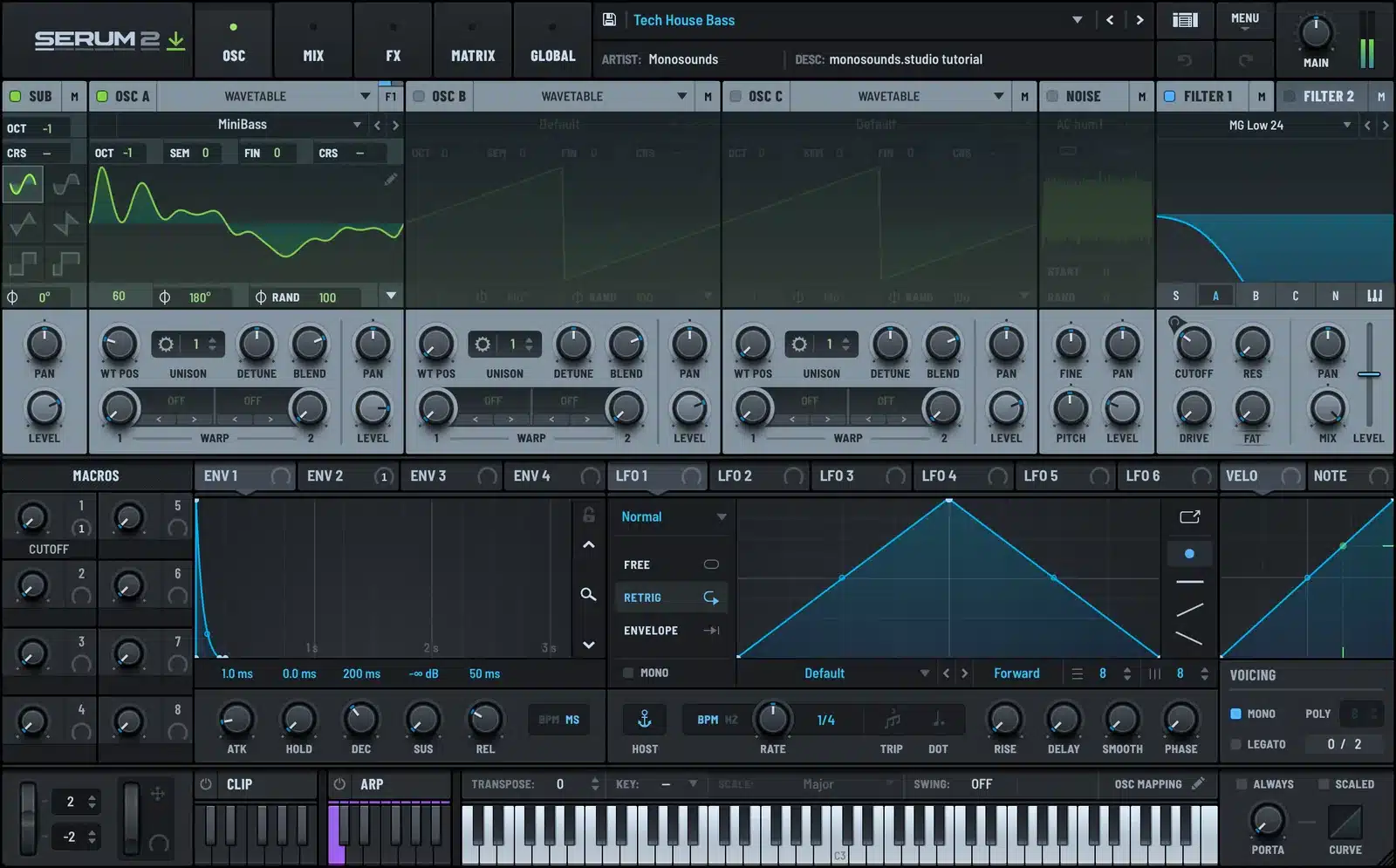
The best bass presets come with bounce already inside: gentle filter or amplitude movement that keeps a loop breathing before you write a single automation lane.
Chord Stabs
The off-beat stab is tech house’s calling card. Tight, percussive, harmonically legible: short attack, quick decay, just enough sustain to imply the chord. Stretch it and the groove smears. Choke it and the harmony disappears. You’re aiming for a punchy transient with a clean 200–400 ms decay.
Leads
Leads in tech house play a quieter role than their EDM cousins. They live in the mids, filtered and slowly evolving, favouring hypnotic motion over big melodic hooks. What you want is slow LFO modulation on filter cutoff; that breathing quality is what sustains interest across four to eight bars of loop.
Atmospheric Pads
Pads here get sensed more than noticed. Wide across the stereo field, tucked just beneath the mix’s surface, supplying harmonic depth without demanding attention. Long attack and release, a touch of reverb baked in, and a frequency range that stays politely clear of the kick and bass.
The Best Serum 2 Preset Packs for Tech House in 2026
1. FISHLAKE Vol.1 — Tech House Serum 2 Presets & Sample Pack
If your budget covers exactly one tech house pack this year, this is it. FISHLAKE Vol.1 pairs Serum 2 presets with a full sample pack (drum loops, one-shots, melodic elements), all built around one sonic identity.
The basses are the highlight: punchy, rhythmically alive, holding the low-mids without clouding the mix. Stabs bring the tight percussive decay this genre insists on, and the pads spread out without hogging space. Since everything was designed as one set, a full track comes together quickly.
Best for: building complete tracks, when presets and samples should speak one musical language.
2. FISHLAKE Vol.2 — Tech House Serum 2 Presets
The sequel, FISHLAKE Vol.2, stretches the palette. Vol.1 leans toward classic tech house warmth; Vol.2 goes harder and more current: tighter basses, meaner stabs, leads with extra bite.
The two volumes complement each other nicely. Vol.1 lays the foundation, Vol.2 supplies edge and variation. Run both and you have material for dozens of tracks with no repeated sounds.
Best for: harder, more contemporary tech house.
3. Techsonic — Tech-House Presets for Xfer Serum 2
Techsonic comes at it from another direction. It embraces the rhythmic, near-mechanical side of the underground club sound: driving basses with hard transients, minimal pads pushed way back, and percussion-like synth textures that layer rhythmic complexity without harmonic clutter.
If Fisher, Chris Lake or John Summit are your references (locked-in, functional, dance-floor-first), this pack had you in mind. Less melody. More groove.
Best for: underground club sounds, minimal and groove-first tech house.
4. Melomagic — House Xfer Serum 2 Presets Mega Pack
For the widest spread in a single download, there’s Melomagic. It spans the whole house spectrum, from deep house, tech house and future house to melodic house and afro house, with 100+ presets in one coherent library.
Its tech house section stands up well: basses balancing warmth against punch, and leads that borrow melodic house’s tunefulness while keeping the functional, hypnotic edge. If you jump between house sub-genres, this one library does the work of three or four packs.
Best for: producers who roam across house sub-genres and want a single covering library.
5. Serum 2 House Presets Vol.1
New to house sound design in Serum 2? Begin with Serum 2 House Presets Vol.1. It handles the fundamentals (classic chord stabs, driving basses, lush pads, expressive leads) with clean, modern production throughout.
It’s broader and less specialised than the FISHLAKE series, which is its strength. Pair it with Techsonic or FISHLAKE and your tech house toolkit is complete.
Best for: building a foundational house preset library.
Budget sitting at zero right now? Take the free Serum 2 presets pack: 271 sounds spanning genres, basses and stabs included, ready to drop into a tech house session so you can test the workflow before paying for anything.
How to Get the Most Out of Tech House Presets in Serum 2
A good preset is where you start, not where you finish. This is what makes them actually work inside a track.
Always Tweak the Filter
The highest-value move on any preset: touch the filter cutoff and resonance. Close the filter 30% and you have a different sound than the same patch wide open. Make it a habit and your library effectively triples.
Use Macro Controls
Professional packs put the parameters that matter onto macros. Give each preset five minutes of macro exploration before it goes in a track; the most interesting sounds often hide at macro extremes you’d never stumble into. If macros and mod routing still feel murky, my Serum 2 modulation guide explains the whole system.
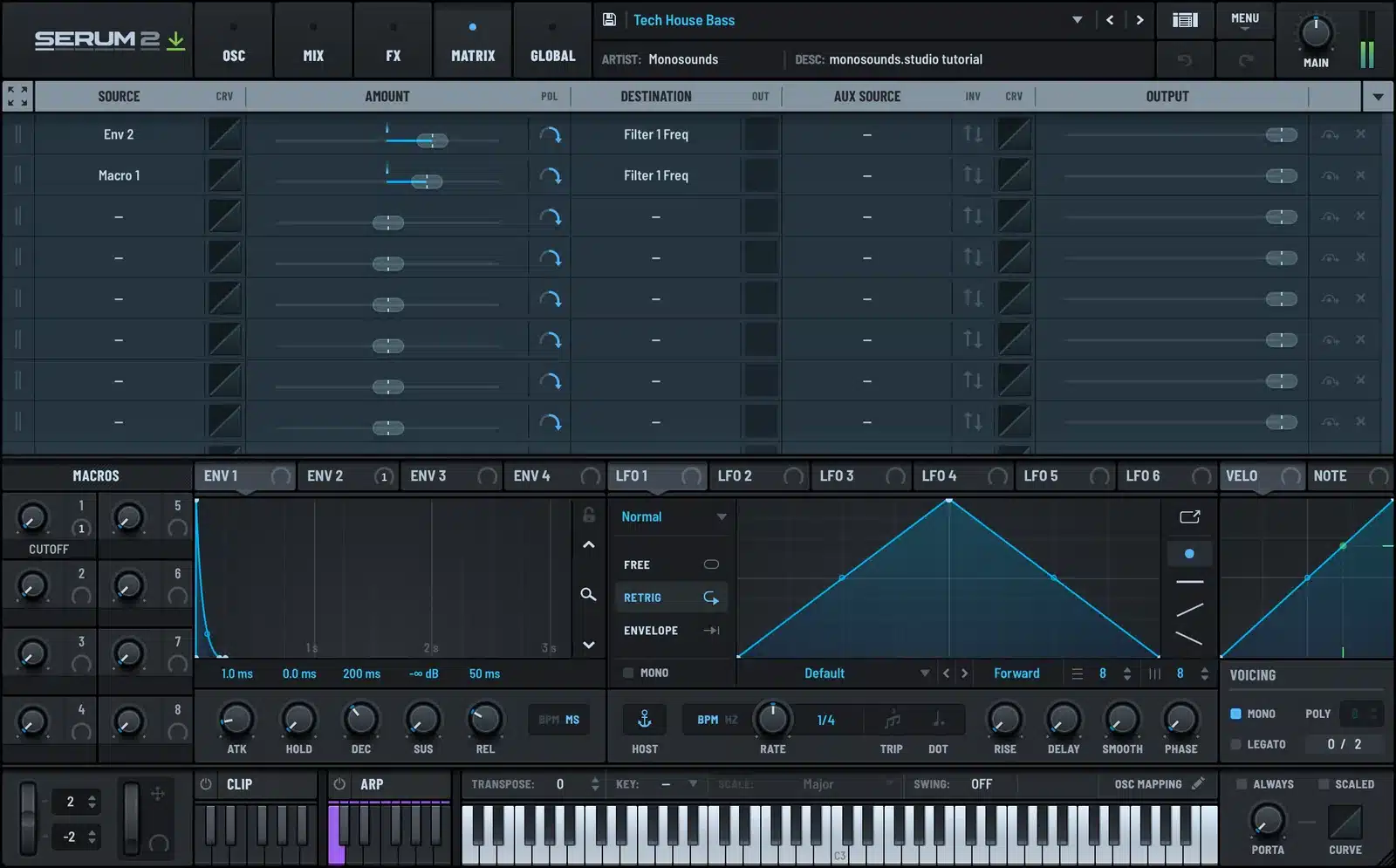
Automate the Filter in the DAW
A static preset reads as static. Write filter cutoff automation across 8–16 bars for gradual builds and releases. Even a quiet 20% sweep over 8 bars keeps a loop in motion without announcing itself.
Layer Basses for Sub and Mid
Most of the big tech house basses are two layers: a clean sine handling the sub (below 80 Hz) and a distorted, harmonically rich preset carrying the mids (80–500 Hz). Sub stays mono; the mid layer gets a little stereo width. The reward is total control of the low end plus cleaner, louder masters.
Sidechain Everything to the Kick
Not optional in this genre. Bass, pads, and any mid-range element all get sidechained to the kick. That pumping, breathing feel is mostly sidechain doing its job: fast attack (1–5 ms), medium release (100–200 ms), 6–12 dB of reduction. Skip it and even the best presets sit there lifeless.
Keep Your Mix Mono Below 150 Hz
Check mono often. Club systems frequently sum everything below 150–200 Hz to mono, and a bass that fills the room in stereo can vanish there if the low end carries stereo information. Keep kick and bass strictly mono and the mix will hold up in a club.
Building a Complete Tech House Track: A Workflow Example
A realistic run from blank session to export, using the packs above:
- Session setup (5 min): 128 BPM, A minor, four-on-the-floor kick in place
- Bass (15 min): pull up a FISHLAKE bass preset, tune it to the root, set the filter cutoff, sidechain against the kick
- Chord stabs (10 min): grab a Techsonic stab, program the off-beat pattern, sprinkle light filter automation
- Lead (10 min): pick an atmospheric lead from Melomagic, write a minimal 4-bar phrase, sweep the filter over 8 bars
- Drums (15 min): clap on 2 and 4, a hi-hat pattern, percussion loops out of the FISHLAKE sample pack
- Arrangement (20 min): intro → build → drop → break → second drop → outro, 6–7 minutes in total
- Mix pass (15 min): EQ, sidechain check, reverb sends, stereo width restricted to the highs
About 90 minutes from empty project to export-ready track. That’s the real case for genre-specific presets: they cut out the sound design hours while leaving all the creative decisions to you.
Tech House in 2026: What’s Changed
The genre has moved a lot in two years. The punchy, sample-driven Fisher/Chris Lake wave has given ground to something subtler, pulling from melodic house and afro house: richer harmony, more considered arrangement, and a production bar that keeps rising.
A pack worth buying in 2026 therefore has to serve both ends: the hard functional groove of classic tech house and the melodic depth of where the genre sits now. That duality was literally the design brief behind the FISHLAKE series and Melomagic. And if your taste keeps drifting melodic, my melodic techno in Serum 2 guide continues where this post leaves off.
FAQ: Serum 2 Presets for Tech House
Do Serum 1 presets work in Serum 2?
Yes. Serum 2 opens Serum 1 presets and they sound identical. Since the upgrade was free for Serum 1 owners, there’s no reason to sit on the old version. Every pack in this post is made for Serum 2.
How do I install tech house presets in Serum 2?
Copy the preset folder into Serum 2’s user presets directory, or go through the menu: Presets → Show Serum Presets Folder. The full step-by-step with screenshots lives in my Serum 2 preset installation guide.
Are these presets royalty-free?
Yes. Everything from Monosounds is 100% royalty-free: commercial releases, client work, streams, no credit and no extra fees. The one restriction: you can’t resell the presets themselves.
What BPM and key should I produce tech house in?
The bulk of tech house lives between 124 and 128 BPM, with 126–128 as today’s club standard. Groove matters more than key, though minor keys rule the genre: A minor, F minor and G minor turn up everywhere. Choose one, hold the bassline inside a tight single octave, and let rhythm carry the track.
Final Thoughts
Serum 2 might be the most capable wavetable synth you can buy. But all that capability only becomes good tech house when the presets were designed for the genre’s very particular demands.
These five collections (FISHLAKE Vol.1, FISHLAKE Vol.2, Techsonic, Melomagic, and Serum 2 House Presets Vol.1) represent the most focused tech house sound design we make. Pick whichever matches your references and go from there.
Not ready to spend money? Start from the 271 free Serum 2 presets, build a loop tonight, and come back for the genre packs once you feel the ceiling. That’s the honest order of operations anyway.

I run Monosounds.studio and make the packs myself. Ten-plus years of producing, 97+ releases, 16,000+ downloads. Every Serum 2 preset we ship passes a CPU check on a mid-range laptop and gets used in a real track before release. If it does not survive a mix, it does not go in the pack.
More about Maxim & the studio →Looking for the packs themselves? Here is browse all Serum 2 preset packs — sorted by genre and by sound, with a demo on every one.


