The low end decides whether a techno track survives. When the bass is right, a two-note loop will hold a warehouse for an hour. When it’s wrong, nothing else you do will rescue the track.
Making preset packs is my day job, and techno bass is one of the topics that lands in my inbox most often. So here’s my honest read: what makes a techno bass actually work, the styles worth knowing, and which of our Serum 2 packs I’d hand you for each.
Some quick 2026 context. Serum 2 arrived in March 2025 as a free upgrade for anyone who owned Serum 1. It brings three oscillators, five engine types (granular and spectral among them), new FX buses and a built-in sequencer. For bass work the practical win is layering room inside a single patch: you no longer need two Serum instances just to run a sub under a mid layer. Still deciding whether to upgrade? I put both versions side by side in Serum 1 vs Serum 2.
Want to hear the sounds before spending money? Start with our free Serum 2 preset pack; there are bass patches in it you can drop into a techno project as-is.
What Makes a Great Serum 2 Bass Preset for Techno
Techno bass is EDM bass turned inside out. No supersaws, no modulation showing off. What you’re after is a tight low end, groove, and movement that hypnotises. Three things carry it.
1. A Clean, Controlled Sub
The fundamental typically lives around 40–60 Hz. Inside Serum 2 that means a sine or triangle on one oscillator, held mono under roughly 120 Hz.
Settings I lean on constantly:
- Oscillator: sine, unison at 1 voice, zero detune on the sub layer
- High-pass every other element of the patch around 100–150 Hz so the sub has that range to itself
- Run the sub 3–6 dB above the mid layer, then verify on headphones and, if possible, something club-sized
That clean sub is the reason a bass translates on a big PA instead of collapsing into mud.
2. Midrange Harmonics for Character
Power comes from the sub, but the midrange is the part people hear on phones and laptop speakers. In techno, character usually comes from FM, gentle distortion or filter drive.
In Serum 2, FM oscillator B from A at 15–30% — that single move turns a boring sine into a growling techno bass. Follow it with the Distortion module in Tube or Diode mode, drive kept low, wet mix rolled back to 30–50%. For a deeper look at routing, my Serum 2 modulation guide goes through the LFO and envelope tricks that put motion into these patches.
3. Tight Envelope Control
Techno bass notes tend to be short and punchy so they lock against the kick. My default: 0 ms attack, decay 150–300 ms, sustain somewhere around 20–40%, release under 100 ms. Rolling lines want the decay shorter; droning hypnotic stuff wants more sustain.
Don’t neglect the filter envelope either. A modest amount on cutoff (20–30%) with a quick decay buys you that plucky forward push while the sub stays untouched.
Techno Bass Styles (and the Presets I’d Use)
Each subgenre asks for its own bass. These are the three styles I field the most questions about.
Deep and Hypnotic Techno Bass
Clean sub, barely any distortion, slow understated movement. It’s the sound of hypnotic, minimal and melodic techno: bass parked low, groove doing the talking.
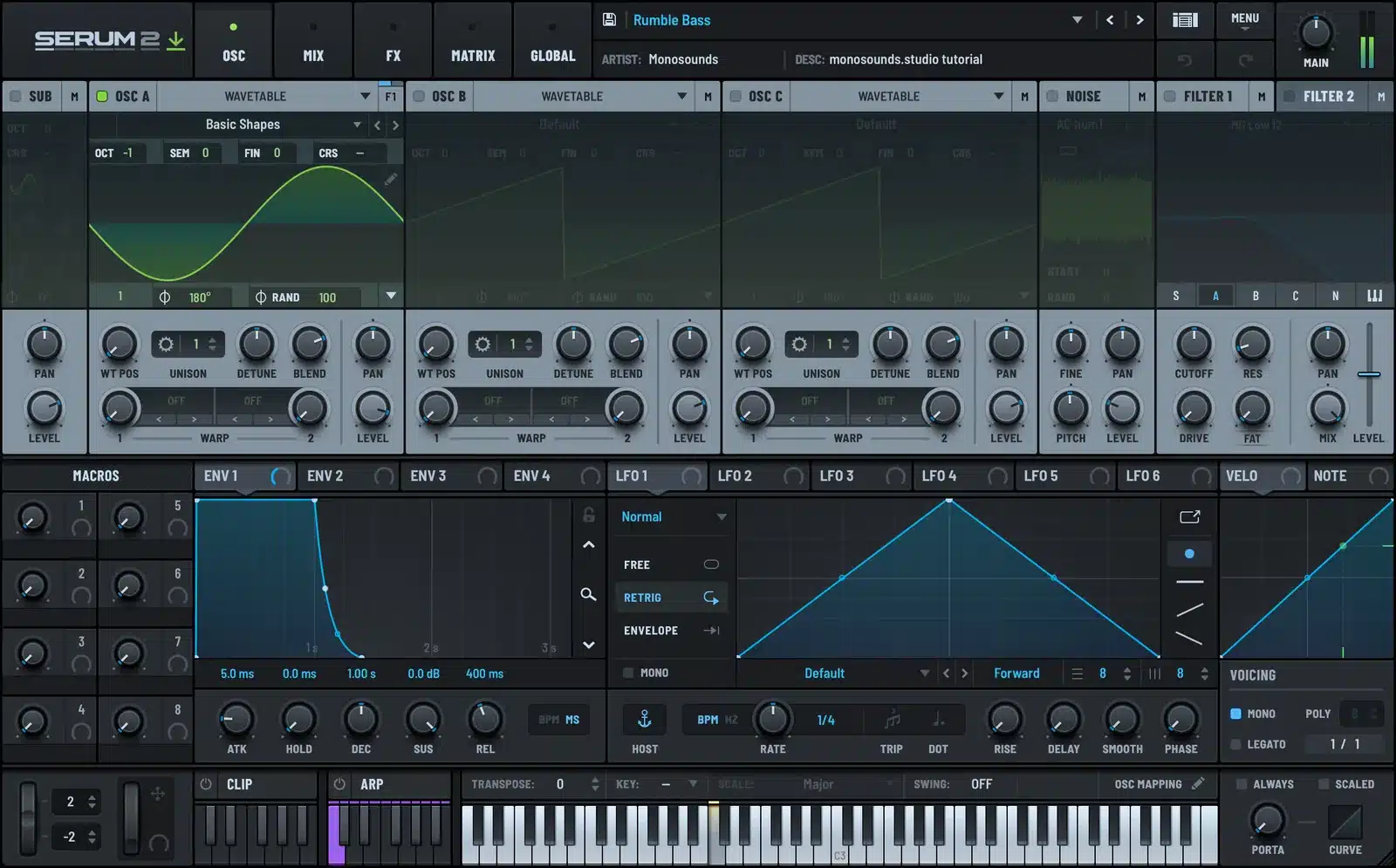
My starting point for this style is our Technocraft techno presets, the pack we designed specifically for club techno, with subs and rumble basses that arrive already mixed tight. On the melodic end, Elixir brings reese basses and atmospheric patches that fit nicely, while the North Sea melodic house and techno pack handles the softer, more emotional territory. There’s also a from-scratch walkthrough of this sound in my melodic techno Serum 2 tutorial.
Distorted Hard Techno Bass
Hard techno is about aggression: saws, heavy saturation, filters pushed hard. The catch: the distortion belongs in the midrange while the sub below stays untouched. Distort the full signal and your low-end weight is gone.
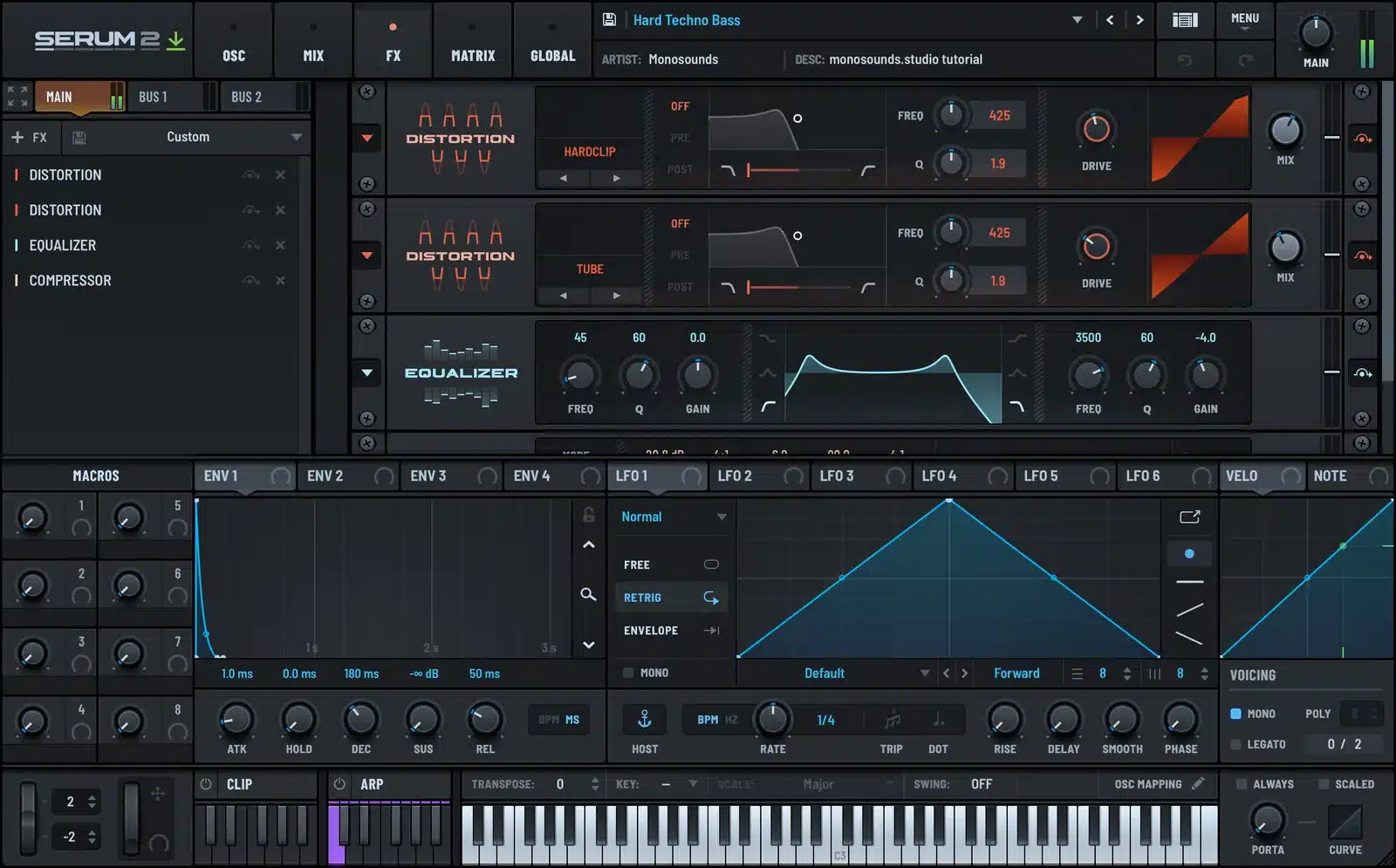
A fast Serum 2 recipe: saw wave, FM at 40–60% for the grit, hard-clip distortion on one FX bus, blended against a clean sine sub sitting on a second oscillator. The multiband options in the new FX buses make this far less painful than it was in Serum 1.
Rolling Techno Bass
Rolling basslines drive peak-time techno and tech house: off-beat 16th-note grooves, filters moving rhythmically, a line that never fully settles.
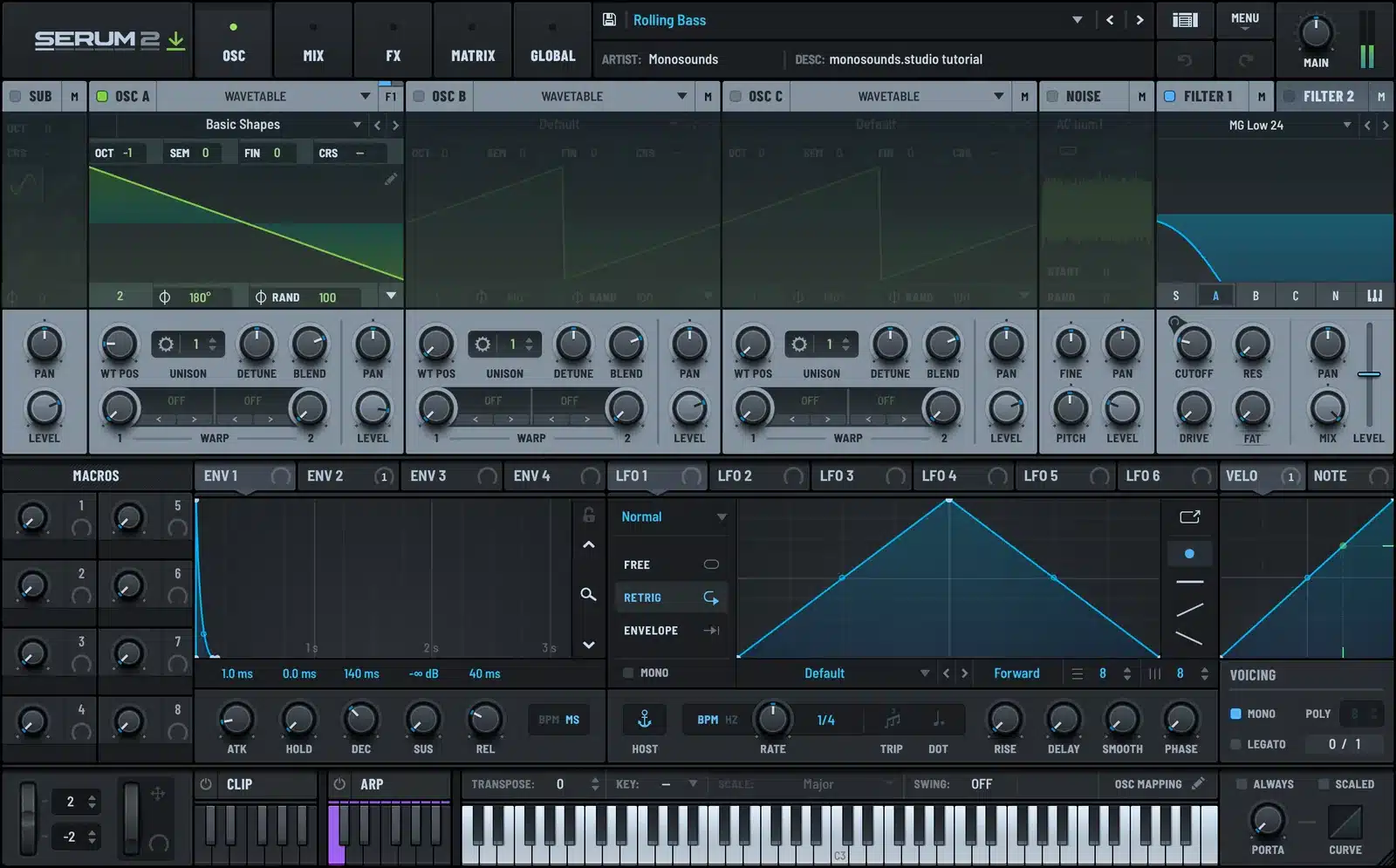
This is exactly where our Fishlake series pays off. Tech House Serum 2 Presets – Fishlake Vol.2 is the more recent set, while FISHLAKE Vol.1 throws in a sample pack alongside the presets. For a third option, Techsonic pushes further into the modern tech house sound. The actual programming (note lengths, velocity, sidechain timing) gets a full breakdown in the tech house bass tutorial.
How to Make Any Bass Preset Sit in Your Track
Even the best preset needs three tweaks before it belongs in a mix. This is the step where most of the demos I get sent go wrong.
Tune It to Your Track
Sounds obvious, gets skipped anyway: confirm the patch is playing in your track’s key, and double-check the octave. Push a techno bass one octave up and the weight vanishes; drop it one down and you get rumble soup. For most club systems the sweet spot is F to A in the first octave, F1–A1.
Saturate Lightly, Not Heavily
A little tape saturation or soft clipping generates harmonics that let small speakers “hear” the bass even when the sub itself is beyond them. Push the drive until you first notice the change, then step back one notch. And if the distortion is already happening inside Serum 2, there’s rarely a need for much more in the DAW.
Sidechain to the Kick — Subtly
Kick and bass are roommates in the low end. In techno the sidechain should register as feel, not as sound: 2–4 dB of reduction with a fast release, nothing like EDM pumping. My habit is to sidechain only the sub layer and let the mids ride; the groove survives and the kick still cuts through.
If the patches sound great but the project starts gasping for CPU once the FX buses stack up, the fixes in Serum 2 CPU optimization are worth a read.
Where to Start: My Shortlist
Forced to name a starter kit for techno in Serum 2, I’d pick:
- Technocraft – the core techno pack: subs, rumbles, stabs
- Fishlake Vol.1 or Vol.2 – rolling basslines for tech house and peak-time sets
- Elixir – reese basses and atmospheres for the melodic end
- The free pack – costs nothing and shows you how our sounds sit in your mixes
Everything stays fully editable, so treat each preset as a launch pad. Change the wavetable, dial the FM amount, redraw the envelopes: that’s the process by which a preset turns into your sound. New to Serum’s preset system? Here’s how to install Serum 2 presets properly.
FAQ: Serum 2 Bass Presets for Techno
Are Serum 2 presets good for techno production?
Yes. Right now Serum 2 sits among the most used synths in techno; wavetable plus FM handles nearly every bass style the genre has, and the granular and spectral engines add textures Serum 1 never could. Plenty of touring techno artists build their basslines with it.
Do Serum 1 presets work in Serum 2?
Yes. Serum 2 loads Serum 1 presets with no conversion step, and the upgrade cost Serum 1 owners nothing. Every pack named here is built and tested for Serum 2.
What frequency should a techno bass sit at?
Put the sub fundamental between 40 and 60 Hz, which lands your bass notes around F1–A1. Keep everything under roughly 120 Hz in mono, and high-pass the rest of the mix so that range belongs to the sub alone.
Can I customize the presets?
Completely. Filters, envelopes, FM amounts, FX buses, macros: every parameter is open. Most producers grab a preset as a fast starting point and shape it from there, and that’s exactly the way I’d use them too.
Final Thoughts
Strip it down and a techno track is kick, bass and conviction. Get the low end sorted and every other decision becomes easier.
Pick a solid preset, tune it, add light saturation, sidechain it gently, then put the hours you saved into groove and arrangement, because that’s where tracks actually get won.
No idea where to start? The free Serum 2 presets pack holds 271 sounds, bass patches included. Grab it, throw a few into a project tonight and see what sticks.

I run Monosounds.studio and make the packs myself. Ten-plus years of producing, 97+ releases, 16,000+ downloads. Every Serum 2 preset we ship passes a CPU check on a mid-range laptop and gets used in a real track before release. If it does not survive a mix, it does not go in the pack.
More about Maxim & the studio →Looking for the packs themselves? Here is my Serum 2 preset packs — sorted by genre and by sound, with a demo on every one.


