
Most of what people say about the Polyvox (Polivoks, Поливокс) is about its filter. The sound going into that filter comes from two plain oscillators, and they are plainer than on most synths of 1982: five waveforms on a click-stop switch, five octave ranges, one detune knob and no pulse-width modulation at all.
This page goes through the two generator plates control by control, with players rendered by Duovox, our reconstruction. At the end are the single cycles we measured on recordings of real units, drawn on top of the plug-in's.
ГЕНЕРАТОР I and ГЕНЕРАТОР II
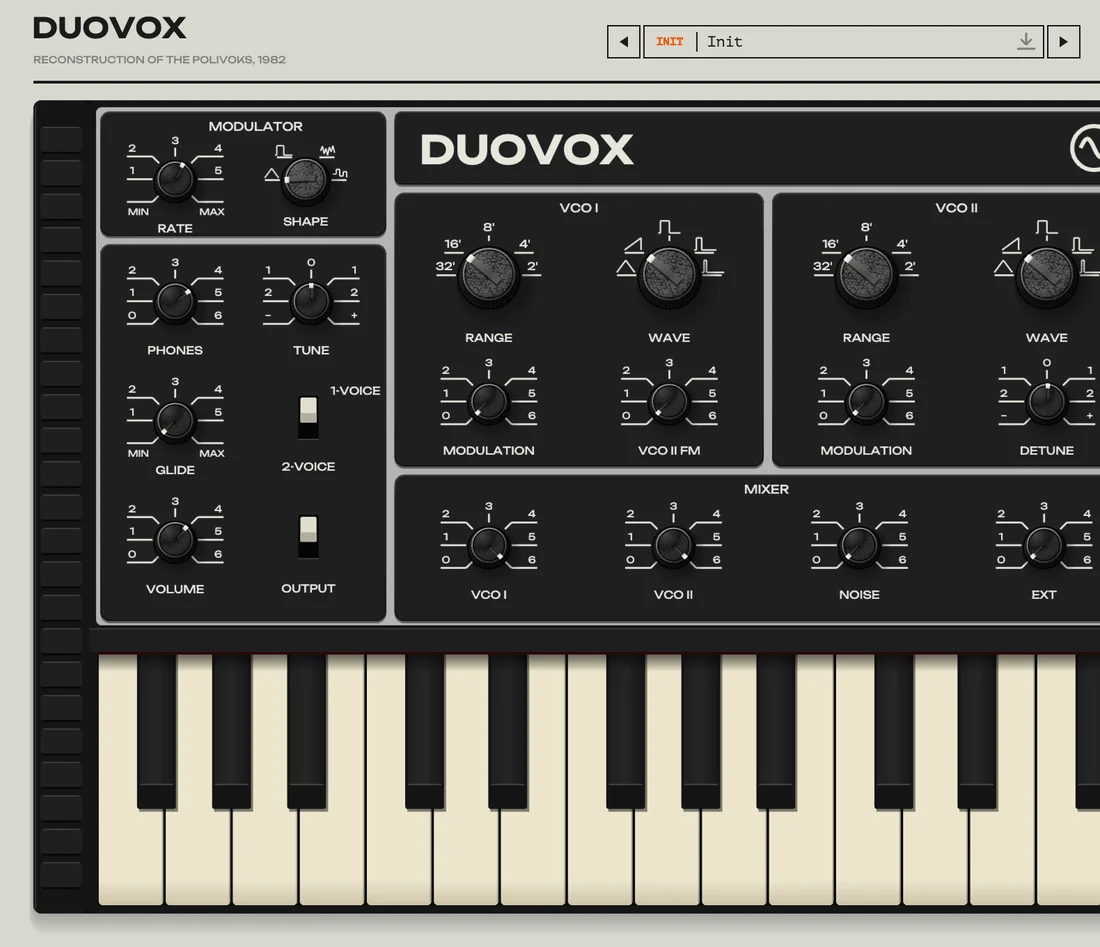
On the 1982 panel the oscillators are called generators: «ГЕНЕРАТОР I» and «ГЕНЕРАТОР II». Each plate has two big rotary switches on top, «ДИАПАЗОН» (range) and «ФОРМА» (form, the waveform), and two small knobs below. On both plates the left small knob is «МОДУЛЯЦИЯ», the depth of the modulator on pitch. The right one differs: on VCO I it is «ГЕНЕРАТОР II», how hard VCO II frequency-modulates VCO I; on VCO II it is «РАССТРОЙКА», detune. Duovox prints them as RANGE, WAVE, MODULATION, VCO II FM and DETUNE when the lettering is set to ABC.
There is no tune knob per oscillator. Master tuning («НАСТРОЙКА», ±1 whole tone by the passport) sits on the left-hand plate and moves both. There is no hard sync either. One online article claims it, but the schematics show none.
Five waveforms and no PWM
Kuzmin's description of the generator is short: a triangle, a sawtooth and three rectangular waves with different duty cycles. Inside, the saw is the core. An op-amp integrator ramps up and a transistor resets it; the triangle is folded out of it with diodes, and the three pulses come from a comparator. The selector picks one, and its icons get thinner from the square to the last pulse.
 WAVE
The widths were never documented. We measured them on recordings of three original units: the medians are 45 % for the square, 20 % for the pulse and 8.8 % for the narrow pulse. Those are the widths Duovox uses. The player holds one note and switches the wave.
The pulse widths show up in the harmonics. A 20 % pulse has no 5th harmonic, and in the Duovox clip the 5th sits 45 dB below the fundamental while the 4th and 6th are only 13 to 16 dB down. The 8.8 % pulse should lose its 11th harmonic and does: 45 dB down, with the 10th and 12th at 21 and 24 dB. The square at 45 % keeps its even harmonics (the 2nd is 16 dB down), which a perfect 50 % square would not.
Level changes with the wave too, as on the hardware. Against the saw the units measured: triangle 1 dB quieter, square 3 dB louder, pulse 2 dB louder, narrow pulse 0.5 dB quieter. In this player, with the mixer at 3, the triangle, the saw and the narrow pulse come out 3 to 4 dB under the square and the pulse.
Pulse-width modulation was common by 1982, and the Polyvox does not have it, as Sound On Sound's audio notes point out. The two narrow pulses are the substitute. Duovox has no PWM either. For movement in a pulse sound, detune VCO II against VCO I on a different width.
Five footages, 21.8 Hz to 5274 Hz
The range selector has five positions marked in organ feet: 32', 16', 8', 4' and 2'. Each step is an octave. 8' is concert pitch, so on the 48-key keyboard (F to E, four octaves) the lowest key at 8' is F2 at 87.3 Hz.
 RANGE
The factory passport gives the full range of the generators as 21.8 Hz to 5274 Hz: F0, the lowest key at 32', to E8, the highest key at 2'. Four octaves of keys plus four octaves of range switch make eight.
The first note in each clip is the bottom key. Measured from the Duovox renders it comes out at 22.1 Hz at 32', then 43.9, 87.5, 174.8 and 349.1 Hz. The 32' note sits about a quarter of a semitone sharp of the passport's 21.8 Hz on purpose. In the multisamples of a third unit we measured, the lowest zone (about 25 Hz) was sharp by 7 to 39 cents in 8 of 12 patches, and Duovox models that as a small leakage current in the core, together with the slightly flat top end that the reset time of the ramp causes (about 5 cents at 1 kHz).
| Range | Lowest key (F) | Highest key (E) |
|---|---|---|
| 32' | 21.8 Hz (F0) | 329.6 Hz (E4) |
| 16' | 43.7 Hz (F1) | 659.3 Hz (E5) |
| 8' | 87.3 Hz (F2) | 1318.5 Hz (E6) |
| 4' | 174.6 Hz (F3) | 2637 Hz (E7) |
| 2' | 349.2 Hz (F4) | 5274 Hz (E8) |
Duovox plays from MIDI, so notes outside the 48 keys work too. The table is the range of the original keyboard.
Detune: ±2 whole tones
VCO II has the only detune knob. Its scale reads 2 1 0 1 2 with a minus and a plus at the ends, and the passport rates it at more than ±25 %, about ±2 whole tones. In Duovox the readout is in semitones, ±4 at the ends.
 8'SawDETUNE
Two things to hear. Near 0, a tenth on the scale (0.2 semitone) makes the two saws beat slowly, which thickens the sound without a chorus. And at exactly 0 the two oscillators keep whatever phase they started in: in this render they partly cancel, and the unison clip is 2 dB quieter than any detuned one. On another note the phase lands somewhere else. The full swing is enough for intervals: +1 is a whole tone, +2 a major third. For a fifth or an octave, use the range switch, and for anything between, detune from there.
Blending the two
Both oscillators meet in the mixer, with noise and the external input. Each level runs 0 to 6, and the summer has unity gain per input with no limit on the sum, which is why the mixer also works as the filter's drive control (the bass tutorial is built on that).
 VCO IVCO II
Here the two are set far apart: VCO I a saw at 16', VCO II a narrow pulse at 8'. The clips are level-matched, so the switch changes only the balance.
From saw only to pulse only, the energy above 2 kHz against the energy below 500 Hz rises by about 11 dB. The pulse an octave up adds a thin top; the saw an octave down keeps the weight. On a real unit, and in Duovox, the two levels also change how hard the filter is driven, so keep the sum in mind when the filter is closed.
A heated chip and a slow wander
The exponential converter turns the keyboard voltage into frequency, and its transistors drift with temperature. Kuzmin's answer was a КР198НТ1А transistor array held at a raised temperature: a tracking circuit around it (a КМ551УД1Б op-amp on the schematic) keeps the chip warm, as he put it, so room temperature matters less. The passport rates the oscillators at less than ±0.5 % drift over four hours.
That did not make every unit stable in practice. Six tuning trimmers hide under the name plate, and Kuzmin recalled that units often left the factory without being calibrated properly. Forty years on, owners still talk about tuning. What we could measure was the slow wander on long held notes: on the third unit about 1 cent standard deviation, 2 to 8 cents peak to peak over 10 seconds.

Duovox puts that on the rear panel as DRIFT. At the default 35 % it gives about 1.1 cents standard deviation and 5 cents peak to peak, each oscillator wandering on its own. The easiest way to hear it is two oscillators on the same note.
With drift at 0 the level of the clip does not move (0.2 dB from the loudest to the quietest 50 ms). At 35 % the two saws slide in and out of phase and the level swings about 6 dB over six seconds; 100 % swings about as far, with the pitch wandering further. On a single oscillator the same drift is a pitch movement of a few cents, which you feel more than hear.
Original cycles against Duovox
To check the waveforms we took recordings of real units: VCO I switched through all five waves with the filter open in a synth4ever demo, a second unit in Nikos Mechanezidis's feature demonstration, and a commercial multisample set of a third. From stable stretches we cut single cycles, aligned and averaged them, and fitted the result against the model through a simple high-pass and low-pass standing in for the recording chain. The recordings were used for measuring only and are not in the plug-in.
Four of the five sit within 4.4 to 6.7 % of the original. The triangle needed the most work: the real one rises over 52 % of the period instead of half, its tips are rounded, and its 2nd harmonic is only about 20 dB down, which a textbook triangle does not have. The saw turned out to be an ideal ramp once the recording chain was modelled, with its reset softened like a 12 kHz pole. The pulse edges are softened at about 5.5 kHz, as a comparator's would be. The pulse and narrow pulse in this comparison come from one unit (19 and 9 % wide); the 20 and 8.8 % that Duovox uses are the medians across all three.
The square is the outlier at 29.4 %. Its width matches; the difference is in the flat tops, which droop differently in the two traces. A flat top is where a high-pass in the signal chain shows most, and the coupling of the recordings we had varied from about 8 to 25 Hz, so we did not chase that number further.
| Measure | Original units | Duovox |
|---|---|---|
| Square width | 42.5 to 49.5 % | 45 % |
| Pulse width | 19 to 21 % | 20 % |
| Narrow pulse width | 8 to 9 % | 8.8 % |
| Triangle rise | 52 % of the period | 52 % |
| Level vs saw | tri −1, sq +3, pulse +2, narrow −0.5 dB | matched |
| Slow pitch wander | ~1 cent sd, 2 to 8 cents p-p | 1.1 cent sd, 5 p-p |
| Octave stretch | none (median −2.5 cents per octave) | none |
The rest of the panel, oscillators included, is playable knob by knob in the sound playground. The VCO II FM knob, which these pages only mention, has its own lesson in FM and ring-mod sounds.
- The full Polyvox panel, control for control, with the scream, the looping envelopes and duophony
- A 4x/8x oversampled model of the two-chip filter, calibrated on recordings of real units
- 257 presets in ten banks and five packs, and a GEN button for new basses, leads and screams
- Extras the 1982 box never had: poly mode, velocity, pitch bend, drift, a rear panel