
The Polyvox (Polivoks, Поливокс) has no ring modulator and no oscillator sync. What it has is one knob on the VCO I plate labelled ГЕНЕРАТОР II, "generator II", which feeds the second oscillator into the first one's pitch at audio rate. Vladimir Kuzmin, who designed the instrument, describes it in one sentence in his article about the design: you can bring one generator's output smoothly into the other and get effects of the ring-modulator kind.
That knob is responsible for most of the metal on the instrument: growling basses, bells, gongs and the clank of machinery. Below it is on Duovox, our reconstruction, where the English panel calls it VCO II FM. The screenshots are the plug-in, the players are renders of it, and the claims about each sound come from measuring those renders.
VCO II bends VCO I, one way only
The two generator plates look almost identical. The difference is the fourth knob. VCO I has VCO II FM; VCO II has DETUNE in the same spot. So the modulation only goes one way: VCO II is always the modulator, VCO I the one you hear bend. Sound On Sound's 2010 retrospective describes it as Osc 2 cross-modulation of Osc 1 for monophonic FM.
 VCO II FMDetune
The FM does not care about the mixer. VCO II modulates VCO I whether or not VCO II's mixer knob is up. Most FM patches turn VCO II down to 0 in the mixer, so you hear only the result. Turn it up and you add the modulator itself, which is how Ring Tear gets its low body.
The FM is exponential. VCO II's waveform goes into VCO I's pitch control the same way the keyboard does (as far as the schematics show), so it moves VCO I in musical intervals, not in hertz. In Duovox the knob at 2.7 swings VCO I about half an octave either way, and at 6 about two and a half octaves. One consequence: exponential modulation pushes the pitch up further than it pulls it down, so VCO I's average pitch rises as you turn the knob. We measured it on a 220 Hz triangle at unison: at 2.7 on the knob the strongest partial moved to 223.5 Hz, at 3.6 to 232 Hz.
There is no sync. Neither Kuzmin nor SOS mentions one, and the panel has no switch for it. If you want the hard, tearing lead people associate with sync, this knob and the hot mixer are the tools.
Low FM under a square bass
The simplest use is a bass. FM Growl Bass is a square on VCO I at 16', with VCO II a triangle an octave lower at 32' and switched off in the mixer. VCO II FM sits at 2.7. Turn the knob in the player and keep an ear on the bottom end.
 32'Triangle2.70
At 0 it is a plain square bass. On the last held D of the riff, the spectrum then has 11 peaks within 30 dB of the loudest, all harmonics of the 74 Hz note. At 1.2 there are 20: new components appear between the harmonics, 37 Hz away from them, which is VCO II's frequency on that key. By 4.8 the strongest component sits at 50 Hz, off the harmonic series altogether, and at 6 there are 37 peaks. You hear it as the bass getting rougher and less sure of its pitch, a growl that sits on top of the note and then swallows it. The useful range for a bassline is 2 to 3.5. Past 4 it stops being a bass.
VCO II's waveform changes the character too. A triangle bends VCO I smoothly up and down. A square flips it between two pitches on every cycle, and a narrow pulse kicks it once per cycle. On a held note at the same depth we counted 6 peaks within 30 dB for the triangle, 8 for the saw, 15 for the square and 17 for the narrow pulse.
VCO II's range sets the spacing
FM on a VCO is easiest to understand from what it does to the spectrum. VCO I's partials stay anchored where VCO I is (pulled a little sharp, as above), and new ones appear above and below it, spaced at VCO II's frequency. That is the same pattern a ring modulator makes with its sum and difference tones, which is why Kuzmin reached for the comparison.
So VCO II's RANGE switch picks the spacing. In the player VCO I is a triangle at 8' and the FM knob is at 3.3; only VCO II's range changes. On middle C the partials come out 65 Hz apart with VCO II at 32', 131 Hz at 16', 262 Hz at 8', 523 Hz at 4' and about 1,050 Hz at 2'. Low VCO II gives a dense, buzzing comb; high VCO II gives a few partials far apart, closer to a bell.
Off the harmonic series
With VCO II on a whole-octave footage and DETUNE at 0, the spacing is a simple multiple of the note, and the result is close to a harmonic tone. Move DETUNE and the spacing stops being a multiple of anything: the partials no longer line up as a harmonic series, and you get bells, gongs and metal. The knob covers 4 semitones either way, and the panel scale marks it in whole tones, 2 on each side of 0.
 4'Square3.7+1.3 st
FM Bell Lead is the factory example: VCO I a triangle at 8', VCO II a square at 4' detuned 1.3 semitones sharp, FM at 3.7, VCO II off in the mixer, and an amplifier envelope that decays to a low sustain. In the player only the detune moves. On middle C the anchor partial stays at 300 Hz for every step, while the next one up slides from 822 Hz at 0 to 957 Hz at full detune.
That 300 Hz is worth a second look. The key is C4, 262 Hz, but exponential FM with a square has pulled VCO I about 2.4 semitones sharp. Bell sounds hide it well, since the ear does not lock onto an inharmonic pitch the way it does on a saw. If a bell has to sit in a chord, play it a tone lower or tune it against the track with the detune knob.
The slow sweep is the most fun way to find a sound. Hold a key and drag DETUNE from one end to the other: the spectrum folds through dozens of ratios, and every few millimetres of travel there is a new bell or a new buzz. When you hear one you like, stop.
Chaos at 6
Turn VCO II FM all the way and VCO I stops having a pitch you can name. On the same 220 Hz test note at unison, the strongest partials at 6 sat at 102, 322, 542 and 762 Hz: still 220 Hz apart, but offset so far that none of them is the note you played. That is the ring-modulator sound in its plainest form.
 MAX · 6
Static Tongue from the EXPERIMENTAL pack lives here, with VCO II a saw an octave down and slightly detuned. Short notes work best. Chainsaw Rip from the INFERNO pack adds noise in the mixer and a high resonance, and Tin Foil uses a high square on VCO II for short clangs. At these depths the filter matters again: a resonant band-pass picks one region out of the mess and makes it ring, which is how Metal Bell, Machine Clank and Broken Gong are built.
Nine metals from one knob
One phrase around C4 through every factory preset in Duovox that leans on VCO II FM. The clips are level-matched as far as a common peak ceiling allows, so the decaying ones (Metal Bell, Broken Gong) sit as loud as the held ones; Machine Clank and Tin Foil, all attack, still come out a few dB quieter.
A few notes on playing them. Broken Gong and Metal Bell want to ring: leave space after each note. Tin Foil and Machine Clank are for staccato hits, more percussion than melody. FM Growl Bass and Chainsaw Rip belong in the low octave. Ring Tear is the one closest to Kuzmin's description, a saw at 8' torn by a saw an octave below at 5.1, with a little of VCO II left in the mixer.
FM with the rest of the panel
FM gets more useful once something else is moving. The modulator can move VCO II's pitch through its own MODULATION knob, which changes the FM spacing in time: a slow triangle on VCO II under a fixed VCO I gives a bell that slowly changes metal. The looping filter envelope can open and close a band-pass on an FM tone for a mechanical rhythm. And because VCO II's DETUNE is a plug-in parameter, automating it from the DAW turns the sweep above into a part.
For more on the oscillators themselves, the oscillator playground lets you hear every waveform and footage. The modulator and its square trill are in the modulator tutorial, and Polyvox for metal and industrial puts these sounds in context.
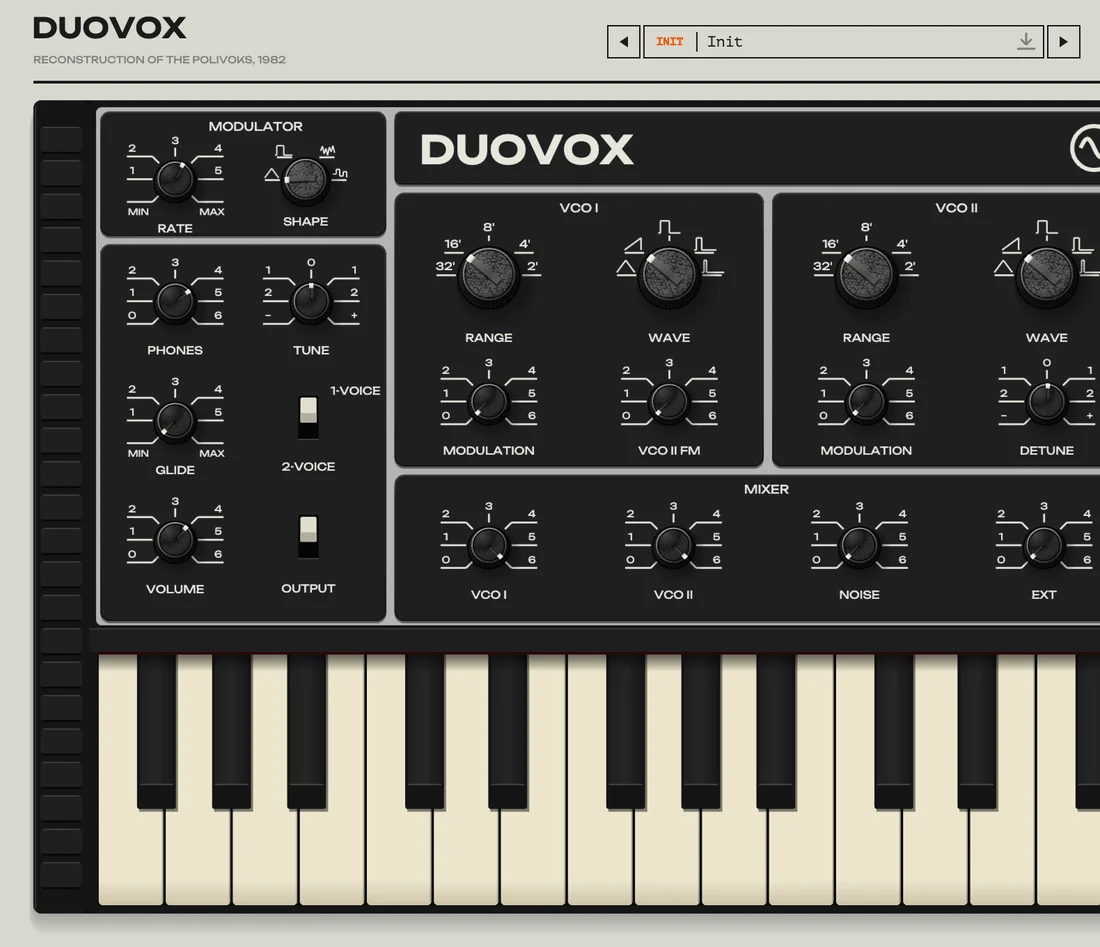
- The full Polyvox panel, control for control, with the scream, the looping envelopes and duophony
- A 4x/8x oversampled model of the two-chip filter, calibrated on recordings of real units
- 257 presets in ten banks and five packs, and a GEN button for new basses, leads and screams
- Extras the 1982 box never had: poly mode, velocity, pitch bend, drift, a rear panel